
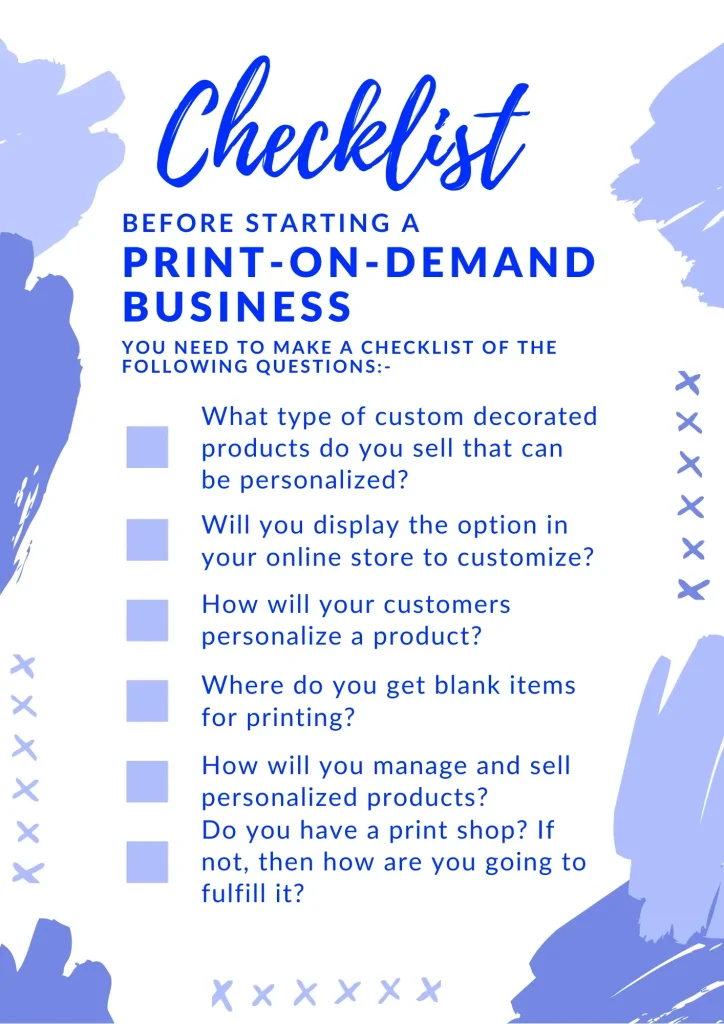
Print on Demand Checklist sets the tone for turning a hobby into a scalable online business, guiding new store owners from idea to launch. This concise framework, inspired by a POD startup guide, helps you prioritize tasks, minimize friction, and avoid costly missteps. By outlining product ideas, supplier choices, design considerations, pricing, SEO, fulfillment, and marketing, it transforms chaos into a clear path. Following this checklist aligns your operations with real-world constraints, helping you build a sustainable, repeatable process from day one. With a focus on practical outcomes, you can move from scattergun experimentation to intentional growth, knowing you are implementing solid processes.
Seen through the lens of on-demand printing, this practical framework helps new shop owners translate ideas into tested product concepts without overcommitting inventory. It emphasizes choosing reliable print partners, evaluating sample products, and building a smooth order-to-delivery workflow that scales with demand. By focusing on brand-aligned designs, accurate color reproduction, and transparent pricing across fulfillment networks, you create a consistent customer experience. The blueprint also covers how to optimize listings, traffic, and post-purchase support within a flexible ecommerce setup that can expand as sales grow. In short, the idea is to convert curiosity into repeatable processes, leveraging dropship-style production with careful design, pricing, and logistics planning.
Niche Definition and Product Ideas: Building a Focused POD Catalog
Start by selecting a niche that fits your interests and has a demonstrated audience. Research trends, search volume, and competitors, then create a small catalog of 10–20 item concepts that clearly align with your brand and resonate with target customers. In a POD startup, map each idea to potential profit margin, production time, and shipping cost to determine which products move forward and which stay on the drawing board. Consider categories like apparel, accessories, home decor, and stationery, and think about how design style, colorways, and sizing affect demand. A focused product strategy often outperforms a broad, unfocused catalog.
This approach aligns with practical guidance found in a POD startup guide and follows print on demand best practices for market fit and operational feasibility. Treat the catalog as a living document that you continually prune based on data, supplier capabilities, and customer feedback, ensuring each item supports your brand story and operational realities.
Selecting a POD Partner and Setting Up a Scalable Store
Choose a reliable POD partner who offers quality print options, fast fulfillment, and transparent pricing. Compare catalogs, sample print quality, and integration with your ecommerce platform. A practical POD startup guide recommends ordering samples, evaluating packaging, and confirming color accuracy from screen to print. Plan for fulfillment strategies that minimize delays, handle international shipping, and provide reliable tracking. As you set up your store, map the customer journey from discovering a product to receiving it, and ensure the platform, domain, payment gateway, and checkout flow scale with demand.
The goal is to streamline daily operations so that your workload stays manageable as you grow. Prioritize a smooth onboarding between your store and your POD partner, establish clear communication channels, and implement standard operating procedures that cover sample testing, order routing, and exception handling for faster resolution times.
Design That Sells: POD Product Design and Fulfillment
Design is the heart of every successful POD product. Develop brand guidelines (logo usage, fonts, color palette) and create designs that look great on multiple products. Use high-resolution artwork and test them on mockups to ensure accurate color representation. Great design reduces returns and improves conversions, and this is where the Print on Demand Checklist shines by keeping your focus on quality and consistency across items.
When crafting designs, keep print constraints in mind—maximum print area, printer color count limits, and how patterns align on different product shapes. If you’re not a designer, consider hiring a freelancer or using design templates that match your brand style. Remember that standout design differentiates your listings in crowded marketplaces and helps your offerings stand out in a sea of competitors.
Pricing, Margins, and Profit Forecasting with Best Practices
Set pricing that covers production, platform fees, marketing, and overhead while remaining attractive to customers. Start with a baseline margin based on supplier costs, then test premium or discount pricing depending on the product and audience. A good practice is to calculate landed cost, including base price, shipping to the warehouse, and any duties if applicable. Use return rate and fulfillment speed data from your POD partner to refine pricing over time. The print on demand best practices emphasize keeping pricing simple and transparent, with clear shipping estimates.
Mapping profitability by product category helps you identify high-margin items and those that need optimization, which is essential for any POD fulfillment strategy. By understanding margins, you’ll know where to invest in design, marketing, and supplier relationships to scale while protecting your bottom line.
SEO-Driven Listings and the Print on Demand Checklist
Product titles, descriptions, and metadata strongly influence search visibility and click-through rates. Write clear, benefit-focused titles that incorporate keywords your customers expect to search for. Use descriptive, concise product descriptions that highlight materials, print methods, care instructions, and sizing. Add alt text to images for accessibility and SEO. For the long tail, weave in related keywords naturally, such as print on demand checklist phrases and POD product design terms. A well-optimized listing improves organic reach and reduces cost per acquisition.
Keep content scannable with bullet points, features, and a compelling call to action. Remember that SEO isn’t about stuffing keywords but about providing useful information that guides the customer toward a purchase. Refer to resources like a POD startup guide for framing your listings, and ensure your keywords align with your overall content strategy and user intent.
Fulfillment, Shipping, and Returns: Streamlined POD Fulfillment Strategies
Clear fulfillment processes prevent delays and protect customer satisfaction. Work with your POD partner to establish average production times, shipping estimates, and order tracking. Create a transparent returns policy and a simple process for exchanges or refunds. Test the end-to-end flow with in-house checks, random samples, and customer feedback. Efficient POD fulfillment strategies emphasize packaging consistency, fast handling times, and accurate order fulfillment.
Document the process and train your customer service team to respond quickly to inquiries about order status, damages, or delays. A smooth logistics experience leads to higher ratings and repeat customers. As you scale, continually refine your workflows, monitor performance against agreed SLAs, and invest in proactive communication so customers feel informed at every stage of the journey.
Frequently Asked Questions
What is the Print on Demand Checklist and how does it function as a POD startup guide?
The Print on Demand Checklist is a practical, living framework that guides new store owners through niche selection, supplier evaluation, design, pricing, SEO, fulfillment, and marketing. It functions as a POD startup guide by outlining actionable steps and helping you stay focused on scalable tasks rather than guesswork.
How should I use the Print on Demand Checklist to validate product ideas and drive POD product design and fulfillment decisions?
Use the Print on Demand Checklist to vet 10–20 product concepts aligned with your brand, assessing potential profit margins, production time, and shipping costs. It emphasizes POD product design and fulfillment—ensuring designs meet print constraints, testing with mockups, and planning efficient production and delivery across product types.
What role does the Print on Demand Checklist play in selecting a POD partner and setting up your store with print on demand best practices?
The checklist guides you through evaluating POD partners against print on demand best practices—quality, pricing, catalogs, and platform integrations. It also covers setting up a streamlined store, including fulfillment strategies, color accuracy, packaging, and reliable tracking to keep operations smooth.
How can the Print on Demand Checklist help optimize pricing, margins, and profitability while following print on demand best practices?
The checklist teaches pricing smartly by accounting for production costs, platform fees, and overhead while applying print on demand best practices. It encourages calculating landed costs, testing pricing tiers, and analyzing profitability by product category to protect margins and forecast profitability.
How does the Print on Demand Checklist guide creating listings that convert and improve SEO for POD fulfillment strategies?
The checklist recommends SEO-focused listing practices: clear benefit-driven titles with relevant keywords, concise descriptions with materials and care details, and image alt text. It also supports integrating related keywords naturally to boost discoverability, aligning content with POD fulfillment strategies for a better buyer journey.
What metrics and processes does the Print on Demand Checklist recommend for measuring performance and scaling with POD startup guide concepts and POD fulfillment strategies?
The checklist advises tracking KPIs such as gross merchandise value, average order value, profit margin, return rate, and customer lifetime value. Use these insights to iterate on product selection, pricing, and marketing, updating the Print on Demand Checklist as you scale and applying POD fulfillment strategies to optimize operations.
| Aspect | Key Points |
|---|---|
| Niche & product ideas | Define a niche with a demonstrated audience; build a focused catalog of 10–20 concepts; map each idea to profit margin, production time, and shipping; ensure alignment with brand; assess how design style, colorways, and sizing affect demand; a focused strategy often outperforms a broad catalog. |
| POD partner and store setup | Choose a reliable POD partner with quality print options, fast fulfillment, and transparent pricing; test samples, evaluate packaging, ensure color accuracy; plan fulfillment strategies, handle customs if selling internationally, and provide tracking; map the customer journey and set up store infrastructure (platform, domain, payment gateway, scalable checkout). |
| Design products that sell | Develop brand guidelines; use high‑resolution artwork and test on mockups for accurate color representation; be mindful of max print area and color count limits; hire a freelancer or use design templates if needed; strong design differentiates listings and reduces returns. |
| Price smart, protect margins, and forecast profitability | Set pricing to cover production, platform fees, marketing, and overhead; compute landed cost; use return rate and fulfillment speed data to refine pricing; keep pricing simple and transparent; analyze profitability by product category to guide optimization. |
| Create listings that convert with strong SEO | Write clear, benefit-focused titles with expected keywords; craft descriptive descriptions including materials, print methods, care, and sizing; add SEO-friendly alt text; weave long-tail keywords naturally; keep content scannable with bullet points and a strong call to action; avoid keyword stuffing. |
| Streamline fulfillment, shipping, and returns | Establish expected production times, shipping estimates, and order tracking with your POD partner; create a transparent returns policy and simple exchange/refund process; test end-to-end flow; emphasize packaging consistency, fast handling, and accurate fulfillment; train customer service for status inquiries and delays. |
| Market, convert, and delight customers | Use a small, repeatable plan combining organic social, paid ads, and email; leverage product-focused content and testimonials; personalize the shopping experience and encourage reviews; set cadences for promotions and product launches; track metrics like CTR, conversion rate, and CPA, then adjust creative and offers. |
| Measure, learn, and scale up | Establish KPIs such as GMV, AOV, profit margin, return rate, and customer lifetime value; use data to iterate product selection, pricing, and marketing; continuously test new designs, products, and supplier options; scale with a proactive, data-driven catalog while maintaining quality and speed. |
Summary
Print on Demand Checklist provides a practical framework for launching and growing a POD store from day one. By focusing on niche selection, strong design, smart pricing, optimized listings, reliable fulfillment, targeted marketing, and ongoing measurement, you create a foundation for long-term success. Use related keywords like POD startup guide and print on demand best practices to inform decisions and stay competitive in a crowded market. As you apply the Print on Demand Checklist, refine workflows, invest in product quality, listen to your customers, and adapt to market signals to scale your store effectively over time.