
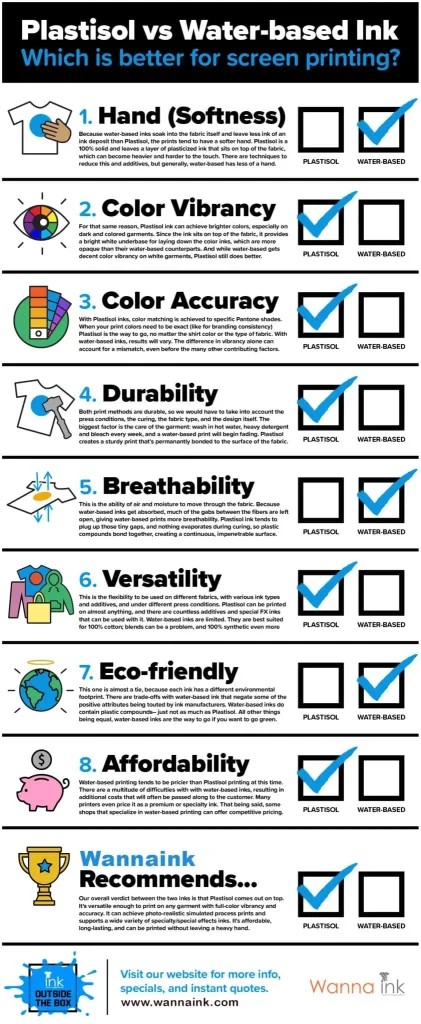
Plastisol vs Water-Based Inks presents printers with a fundamental decision that shapes opacity and overall durability across fabrics. In the broader world of screen printing, each system offers distinct strengths depending on the substrate and the project goals. Plastisol typically creates a surface film that yields strong opacity on darker garments and durable color. Water-based inks, by contrast, can deliver a softer hand and better fabric integration, at times trading opacity for comfort. Understanding these trade-offs helps designers plan for different garment types and production budgets.
From an LSI-informed perspective, you can think of the first option as a surface-applied pigment ink and the second as a fiber-penetrating system. That reframing helps teams assess opacity on dark fabrics, print hand feel, and long-term performance without getting lost in jargon. For dense colors, practitioners may rely on a base layer strategy with water-based inks, while surface-printed options often achieve strong coverage in fewer passes. Careful control of heat, substrate, and cure timing remains essential to protect durability and wash outcomes. Together, these alternative terms guide conversations about which approach best fits the garment, budget, and production schedule.
Plastisol vs Water-Based Inks: Core Differences in Opacity, Hand Feel, and Durability
Plastisol sits on top of the fabric, forming a dense, flexible film that delivers strong opacity, especially on dark fabrics. This surface layer makes opacity in screen printing one of Plastisol’s core strengths, allowing bold color and consistent coverage over black or navy tees. The relative simplicity of achieving opacity with Plastisol also ties into its durability, as the film resists cracking and fading through wash cycles.
Water-based inks soak into fibers, yielding a softer hand and more breathable prints. This soft hand of ink is a key draw for fashion tees and performance fabrics where comfort matters. However, achieving similar opacity on dark garments often requires a white underbase, multiple passes, or pigment concentrates designed for dark bases, which touches on the white underbase for water-based and the overall screen printing inks comparison. With proper curing, water-based prints can be durable too, though wash fastness can vary with fabric and laundering conditions.
Screen Printing Inks Comparison: Choosing Based on Fabric Type and Substrate
Choosing inks also depends on fabric type and substrate. For 100% cotton, water-based inks can deliver a soft hand while maintaining color fidelity; for synthetic blends, Plastisol’s film formation tends to be more reliable and consistent across a broad range of fabrics. This decision point ties directly into durability of screen printing inks and the overall durability in real-world washing.
Consider performance on blends and synthetics: some water-based formulations adhere well, while others may require pretreatment or specialized binders to ensure color accuracy and long-term adhesion. This is a key aspect of the screen printing inks comparison, and it often influences curing temperatures of ink and cleanup workflows depending on substrate and production volume.
Opacity on Dark Fabrics: Plastisol vs Water-Based Inks Advantage
On dark fabrics, Plastisol usually achieves true opacity with fewer layers because the pigment sits on the surface and reflects light in a way that maximizes coverage. This opacity advantage is a central reason printers choose Plastisol for bold graphics on black garments and navy tees, where color density and edge crispness matter most.
Water-based inks can be made to approach similar opacity, but often require a white underbase for dark fabrics and potentially more passes. The trade-off is a softer hand once cured, aligning with the soft hand vs stiffness goal. When white underbases are employed with water-based inks, color pop can be strong, but the process carries a higher sensitivity to mesh choices and curing control to preserve durability.
Soft Hand and Comfort: Achieving a Great Hand Feel with Water-Based Inks
Water-based inks are celebrated for a soft hand that blends with the fabric rather than sitting on top. This soft hand of ink reduces stiffness, improves breathability, and is particularly appealing for activewear and fashion tees where comfort matters and the hand feel of ink is a priority.
However, achieving consistent color density while preserving a soft hand requires careful formulation and process control. The durability of screen printing inks remains strong with proper curing, but the print may require more precise mesh counts, binder selection, and substrate compatibility to maintain wash fastness and long-term performance.
Curing Temperatures and Process Control: Ensuring Long-Lasting Prints
Plastisol cures reliably at typical temperatures around 300°F (150°C) for a short dwell, with process parameters that are well established across many shops. This curing regimen supports strong wash fastness and durable color development, making it a predictable choice when throughput and consistency are critical.
Water-based inks require precise heat control to fully cure the binder and prevent issues such as incomplete cure or dye bleed. Wrong curing temperatures can affect durability and hand feel and even lead to ink cracking or washing out; thus curing temperatures of ink are a central consideration in process planning and quality assurance.
Practical Workflow and Hybrid Strategies: Blending Benefits of Plastisol and Water-Based Inks
Many shops use a pragmatic mix: Plastisol for core colors or base layers on dark fabrics, with water-based inks for overlays or accents to achieve a soft hand while maintaining opacity where needed. This hybrid approach leverages the durability of Plastisol and the soft hand of water-based inks, offering a balanced solution for mixed production runs.
Testing is essential: run test swatches on actual fabrics, optimize mesh counts and squeegee pressure, and consider white underbases for water-based inks when opacity is required on dark garments. Exploring hybrid or specialty inks can reveal a middle ground for both opacity and hand feel, while keeping an eye on durability and wash fastness across different fabrics and laundering conditions.
Frequently Asked Questions
What is the difference in opacity in screen printing between Plastisol vs Water-Based Inks on dark fabrics?
Plastisol inks sit on top of the fabric, delivering high opacity on dark fabrics with fewer coats. Water-based inks soak into fibers and often require additional passes or a white underbase to reach comparable opacity on dark garments. This opacity difference is a key consideration when choosing Plastisol vs Water-Based Inks for bold designs.
How do hand feel and durability compare in Plastisol vs Water-Based Inks?
Plastisol typically feels thicker and stiffer on garments, especially on lighter fabrics, while water-based inks produce a softer hand and greater fabric flexibility. In terms of durability, Plastisol forms a durable film with strong wash fastness; water-based inks can also be durable when properly cured and matched to the fabric, though results can vary.
Which ink offers better wash fastness and durability: Plastisol vs Water-Based Inks?
Plastisol generally offers excellent wash fastness and durability due to its surface film. Water-based inks can be durable as well, but typically require careful curing and substrate preparation to maximize wash resistance.
Can you achieve white underbase with water-based inks and how does it compare to Plastisol underbase?
Yes, water-based inks often need a white underbase on dark fabrics to reach opacity, which adds steps. Plastisol typically delivers opacity more readily and may require fewer underbases, making it a simpler option for solid coverage on dark garments.
What curing temperatures of ink should I use for Plastisol vs Water-Based Inks to avoid cracking?
Plastisol cures around 300°F (150°C) for a short dwell. Water-based inks require precise curing to ensure full film formation and wash durability; under-curing can lead to poor adhesion, while over-curing can risk fabric damage. Always verify curing with your specific formulation and fabric.
Which scenarios favor fabric printing on dark fabrics using Plastisol vs Water-Based Inks?
For dark fabrics, Plastisol’s opacity and bold color performance are a strong advantage. Water-based inks excel for a soft hand and breathable feel, particularly on lighter fabrics or fashion garments. Many shops use a combination—Plastisol for base layers on dark fabrics and water-based inks for overlays—to balance opacity and hand feel.
| Aspect | Plastisol Highlights | Water-Based Highlights | Practical Takeaway |
|---|---|---|---|
| Opacity on dark fabrics | Excellent opacity; pigment sits on surface for bold, opaque colors. | Opacity on dark fabrics is lower; may require white underbase or extra passes. | Best choice for strong coverage on dark textiles. |
| Hand feel | Thicker, sometimes plasticky feel, especially on lighter garments. | Soft hand, breathable, integrates with fabric. | Water-based preferred where hand feel matters. |
| Durability / wash fastness | Film on surface; very durable; strong wash fastness. | Durable with proper curing; softer hand may vary after wash. | Both can be durable; ensure proper cure. |
| Substrate compatibility | Very versatile across cotton, blends, synthetics. | Excellent on 100% cotton and some blends; synthetics may require pretreatment. | Choose based on fabric type. |
| Curing requirements | Cures with heat, around 300°F (150°C) for a short time. | Requires precise curing; under- or over-curing can cause issues. | Control curing temperature and time carefully. |
| Environmental impact & cleanup | PVC-based; odor and waste considerations; reducer use. | Lower VOCs/odor; easier cleanup with water; more eco-friendly in many cases. | If sustainability matters, water-based often preferred. |
| Opacity on light fabrics / color vibrancy | Bright, vibrant colors with high opacity; fewer coats on light fabrics. | Vibrant colors possible with pigment concentrates; may need more coats for full opacity on dark fabrics. | Consider color goals and underbase needs. |
| Underbase considerations | Typically no white underbase required for many colors. | White underbase commonly needed on dark fabrics to achieve opacity; adds steps. | Plan underbase requirements in production. |
Summary
Plastisol vs Water-Based Inks: a comparative overview shows how each ink system brings distinct strengths to screen printing. Plastisol offers superior opacity, strong durability, and versatile substrate performance, making it ideal for bold designs on many garment types and high-volume runs. Water-based inks deliver a softer hand, better fabric integration, and often a lower environmental footprint, making them appealing for fashion tees, athletic wear, and fabrics where comfort matters. Choosing between them depends on the target fabric, design goals, durability expectations, and production workflow. In practice, many shop pipelines blend both systems—Plastisol for base layers or bold highlights on dark fabrics, and water-based inks for overlays and accents to maximize comfort and wash performance. Testing on actual garments, controlling curing precisely, and planning underbases where needed are key steps to achieving consistent results. Ultimately, understanding the trade-offs in opacity, hand feel, wash fastness, and durability will help printers select the right ink strategy for each project.